Malawi’s industrial production remained under pressure this year, with manufacturing emerging as the biggest drag on growth, the National Statistical Office (NSO) data show.
The NSO Index of Industrial Production, which measures changes in the volume of goods and services produced across an economy’s industrial sector over time, shows that manufacturing recorded a negative contribution of 11.8 percentage points to the annual average growth rate of industrial production. This is against an overall negative contribution of 12.1 percentage points.
The decline was largely driven by tobacco manufacturing, which contributed minus 13.6 percentage points while rubber and plastics products contributed minus 6.1 percentage points and chemical products minus 2.7 percentage points.
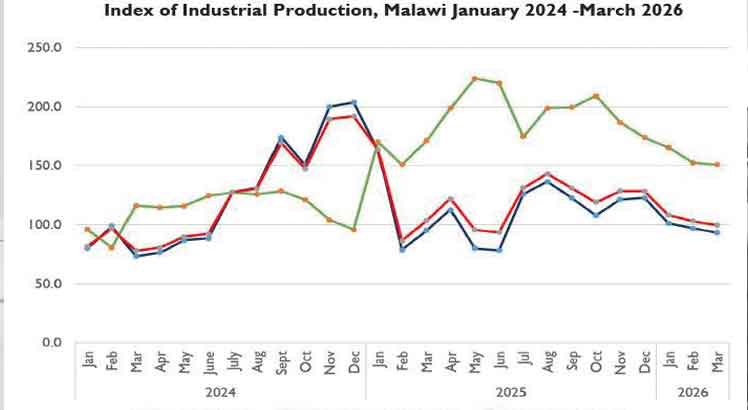
During the period, most industrial categories recorded a decline in production, with rubber and plastics products falling by about 84 percent and tobacco products by 28.7 percent, according to the report.
Electricity and water production also declined by 4.7 percent.
Commenting on the development, trade expert Paul Kwengwere observed that the drop exposes critical vulnerabilities in the country’s business ecosystem and indicates that the manufacturing and industrial sectors are bearing the brunt of ongoing structural shocks.
He said that for an economy aiming for structural transformation, this proves that stabilising the macroeconomic environment—specifically exchange rate predictability and utility reliability—must happen before any industrial recovery can take root.
Said Kwengwere: “Such a contraction in a vital productive sector dampens the country’s near-term economic recovery, shifting the burden entirely onto other sectors.
“Looking at the sectors that are key in this decline, rubber and plastics, we can see that both rely heavily on external inputs which means they are functionally paralysed by the foreign exchange shortage. Meanwhile, the domestic infrastructure meant to support these businesses [utilities] is shrinking rather than expanding.”
On his part, Malawi Confederation of Chambers of Commerce and Industry (MCCCI) president Ronald Ngwira said in an interview that the recovery will be a long painful journey that requires deliberate and intentional paradigm shifts that we are currently not doing at speed.
He said: “Malawi is facing significant headwinds and these have long-term effects on productivity and competitiveness of Malawian companies versus imports for those who can source dollars at the official exchange rate and so we have seen the importation coming in at the expense of domestic producers.”
At the same time, the share of manufacturing to the gross domestic product (GDP) had shrunk over the past decade, with the Reserve Bank of Malawi data showing that the sector’s contribution slipped from 11.3 percent to 11.1 and an annual growth rates averaging just 0.5 percent since 2023.
MCCCI Business Climate Survey also found that most firms are operating below capacity with 51.9 percent of them operating below 50 percent utilisation, 37 percent operating between 50 percent and 75 percent with only 11.1 percent operating above 75 percent.
The industrialisation pillar in Malawi 2063 seeks to transform Malawi into a productive, export-oriented and self-reliant economy by 2030 and an upper middle-income economy by 2063 through value addition, agro-processing, manufacturing, mining and infrastructure development.
Ministry of Finance, Economic Planning and Decentralisation spokesperson Williams Banda earlier cited capital and energy constraints as key barriers, but noted that falling interest rates, driven by reduced government borrowing, are easing pressure on production.